
Latency Destroys Runway: The CFO's Case for Financial Automation
How fragile finance functions become antifragile through automation
How many hours did your team spend on last month's close?
Now subtract the time spent on actual strategic analysis—the thinking, the pattern recognition, the recommendations that changed decisions.
What's left is your fragility tax.
For most finance teams I work with, that tax runs 80-90%. Eight or nine out of every ten hours spent on data wrestling—copying between systems, reconciling discrepancies, reformatting reports, verifying that the numbers match. Not insight. Not strategy. Not decisions that move the business forward.
That's not just inefficiency. That's fragility.
When the vast majority of your finance function's output is mechanical data wrestling, you don't have a team of analysts. You have a team of highly-paid typists operating a system that breaks if anyone leaves, calls in sick, or makes a copy-paste error. Your financial truth is held hostage by a spreadsheet that nobody fully understands.
It's 2026. AI and robotic process automation are slashing financial reporting errors by 90% and accelerating processes by 85x in companies that have made the switch.1 Real-time forecasting is no longer a fantasy. Integrated reporting is no longer "nice to have."
And yet, most finance teams are still trapped in spreadsheet purgatory—not because they don't know better, but because the immediate comfort of the familiar feels safer than the short-term pain of building something new.
That's high time preference behavior. And it's making your organization fragile.
The 2026 Reality: Banking FP&A Has Already Shifted
Walk into any major financial institution's FP&A department today, and you won't find analysts manually copying data between tabs. You'll find:
- AI-driven variance analysis that flags anomalies in seconds, not days
- Automated consolidation engines that pull from dozens of source systems overnight
- Predictive forecasting models that adjust in real-time based on market conditions
- Natural language querying where leadership asks questions and gets answers immediately
This isn't emerging technology. This is standard practice in sophisticated finance organizations.
The gap between leaders and laggards is no longer about talent or budget. It's about willingness to accept short-term discomfort for long-term antifragility.
The spreadsheet isn't just slow. It's a source of fragility that threatens your ability to respond when reality shifts.
The Hidden Costs That Automation Reveals
When companies finally automate their financial reporting, something surprising happens: they discover costs they couldn't see before.
Spreadsheets create opacity. Automation eliminates it.
Here's the pattern I see repeatedly: A finance team spends 40+ hours per month consolidating data from multiple systems—QuickBooks, Salesforce, acquired entities, whatever the stack. They know it's painful, but they've normalized it. "That's just how financial reporting works."
Then they automate. And the time savings become the headline—but they're not the real story. The real story is what they discover once they can actually see their data:
- Duplicate costs across entities that nobody had visibility into because the data was siloed
- Pricing inconsistencies between products that were eroding margin—invisible in aggregate, obvious with drill-down
- Cash collection delays hidden in rolled-up numbers that only become apparent with entity-level or customer-level views
But here's what most people miss: the time savings aren't the point. The visibility is the point.
When a CFO can't answer basic questions without waiting days for a report, that's not an efficiency problem. It's an opacity problem. They're flying blind. And when you're flying blind, you can't see the terrain you're about to hit.
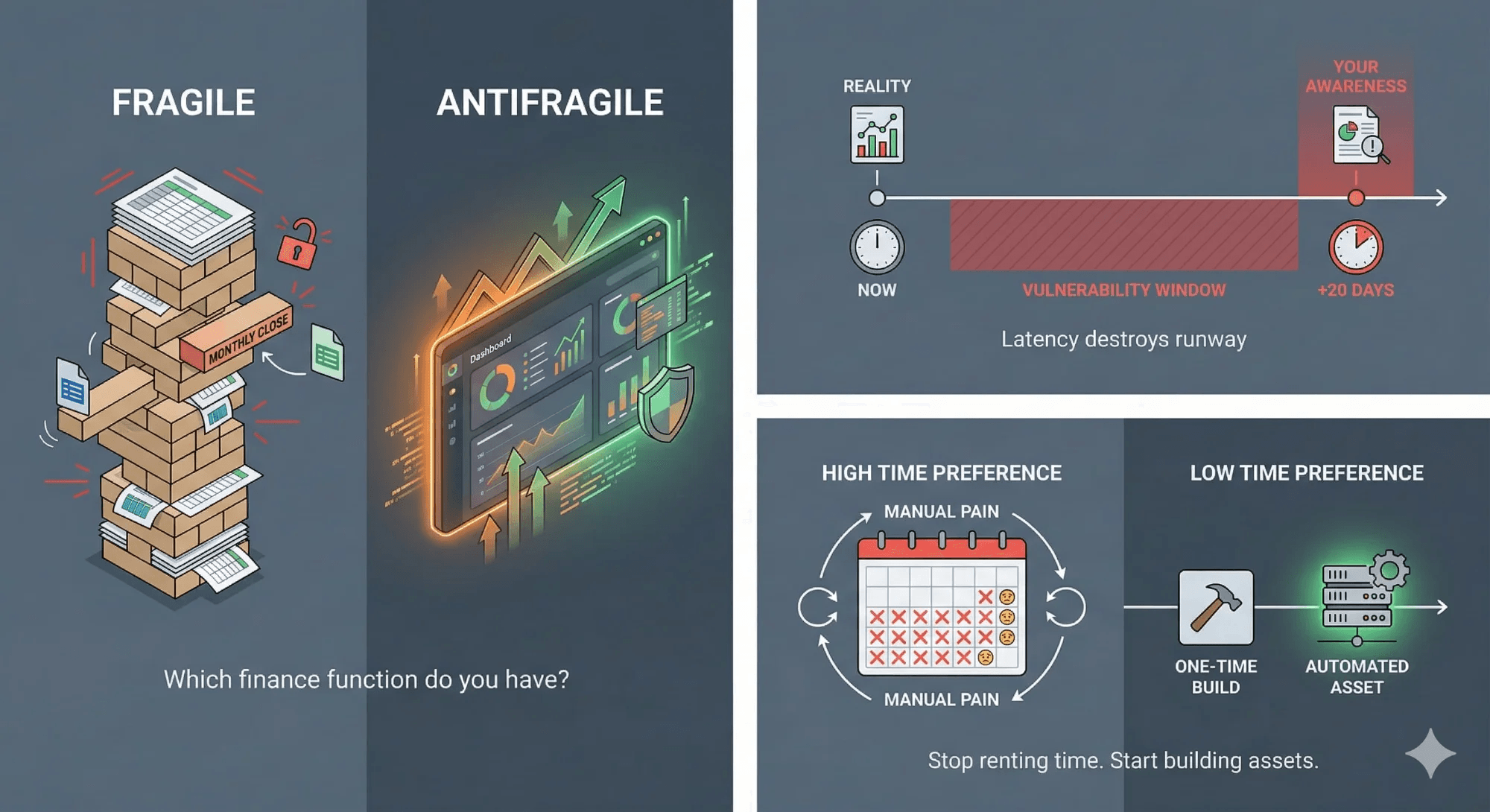
Latency destroys runway.
If your data is 20 days old, your decision-making is lagging reality by 20 days. In a crisis, that lag is the difference between correcting course and hitting the wall. You cannot have sovereignty if you are operating on a delay.
You cannot say "no" to a threat you cannot see.
10 Signs You've Outgrown Spreadsheets (2026 Edition)
I wrote a guide called "10 Signs You've Outgrown Spreadsheets" that's helped hundreds of finance leaders diagnose their situation. But 2026 demands an update—not just for new technology, but for a sharper understanding of what's actually at stake.
These aren't just signs of inefficiency. They're signs of fragility.
1. Your Competitors Have Real-Time Dashboards (You Don't)
If your leadership is still waiting 3-5 days for monthly reports while competitors make decisions with live data, you aren't just slower. You're operating with informational opacity.
Every day between reality and your awareness of it is a day of vulnerability. Your competitors see the market shifting now. You see it later. In a volatile environment, that lag isn't an inconvenience—it's an existential risk.
2. You're Hiring Analysts to Manage Spreadsheets
Every finance hire who spends 70% of their time on data prep instead of strategic analysis is an automation investment deferred.
Worse: you're scaling your fragility. More people doing manual work means more opportunities for error, more institutional knowledge locked in individual heads, more chaos when someone leaves.
A Sovereign CFO builds systems that scale. A fragile CFO builds headcount that doesn't.
3. AI Tools Exist for Your Exact Problem (You Haven't Evaluated Them)
In 2024, evaluating AI for finance was optional. In 2026, it's negligent not to. Tools like AI-powered anomaly detection, automated consolidation, and predictive modeling are mature.
The question isn't "does it exist?" It's "why aren't we using it?"
If the answer is "we don't have time to evaluate" or "we'll get to it next quarter"—that's high time preference thinking. You're choosing the immediate comfort of the known process over the short-term pain of implementation for long-term gain.
Every month you delay is a month of accumulated fragility.
4. Your Variance Analysis Takes Days, Not Minutes
Modern FP&A platforms flag variances automatically, categorize them by materiality, and even suggest root causes. If your team is still manually comparing columns and writing variance narratives from scratch, you're not just working too hard.
You're discovering problems after they've already done damage.
Variance analysis isn't a reporting exercise. It's an early warning system. If your early warning system has a 5-day lag, it's not early anymore.
5. Nobody Trusts the Numbers Without Double-Checking
"Can you verify that?" is a symptom of a broken system.
When trust requires manual verification, you've created a system that generates work instead of eliminating it. Every hour spent double-checking is an hour that proves your process isn't reliable.
Automated pipelines with built-in validation rules create trust by design. Human verification becomes exception handling, not standard practice.
6. Version Control is Still a Problem
Final_Budget_2026_v4_REVISED_FINAL.xlsx
If you're still emailing files with version numbers in the filename, you haven't solved the problem. You've institutionalized chaos.
Version control isn't about organization. It's about single source of truth. When multiple versions exist, reality becomes negotiable. And negotiable reality is the enemy of good decisions.
7. Acquisitions Break Your Reporting Process
Every new entity should be a configuration change, not a rebuild.
If your spreadsheet consolidation process can't handle a new acquisition without months of rework, you don't have a scalable system. You have a system that punishes growth.
Fragile systems break under stress. Antifragile systems get stronger.
8. Your CFO Can't Get Ad-Hoc Answers Immediately
"I'll get that to you by end of week" is an unacceptable answer in 2026.
Leadership should be able to query the data themselves, or get AI-assisted answers in minutes. Every question that requires a multi-day turnaround is a decision made with incomplete information—or a decision delayed until the window has closed.
9. You Can't Model Scenarios Without Breaking Things
What happens if revenue drops 20%? What if we delay that hire? What if we raise prices 15%?
If these questions require rebuilding your model, you don't have a forecasting tool. You have a historical record that happens to look forward.
Antifragile finance functions can stress-test scenarios in hours. Fragile ones can't stress-test at all—they're too busy maintaining the baseline.
10. You're Aware of the Problem (But Haven't Acted)
This is the most dangerous sign.
You know spreadsheets are costing you time, accuracy, and strategic capacity. You've read articles like this one. You've nodded along in meetings about "digital transformation."
But you haven't acted. Because the pain of the current state is distributed across months, and the pain of change is concentrated in weeks.
That's high time preference. That's how fragility compounds.
The Sovereignty Angle: Automation is Anti-Fragility
Most people sell automation as "efficiency." I'm telling you it's sovereignty.
When your financial truth is locked inside a fragile spreadsheet that breaks if one person leaves, your organization is vulnerable. You are dependent on a specific human executing a specific manual sequence correctly every single time. That is the definition of fragility.
Sovereignty is measured by how long you can say no.
In finance, you cannot say "no" to a bad market turn if you don't see it coming until the month-end close. You cannot say "no" to a cash crunch if your forecasting model takes three days to rebuild. You cannot say "no" to a bad acquisition if you're still integrating the last one's data.
Clinging to spreadsheets is high time preference behavior. It is borrowing time from your future self—hours of manual labor every month—to avoid the immediate discomfort of building a system.
A Sovereign CFO creates assets (systems) that produce leverage.
A fragile CFO rents their own time to the spreadsheet.
And here's the part nobody talks about: cognitive sovereignty.
A CFO buried in data entry is captured. Their mind is occupied with rote verification and "spreadsheet gymnastics" instead of pattern recognition and strategic perception. They are looking backward at what happened, not forward at what is coming.
You cannot be the pilot if you are shovel-coaling the engine.
When you automate, you aren't just saving 40 hours. You are moving your finance function from Vulnerable (reacting to the past) to Antifragile (prepared for volatility).
Manual reporting is high time preference. It creates a debt of time you must pay every month.
Automated reporting is low time preference. It is an asset that works while you sleep.
That's the 85x return that actually matters. Not efficiency. Freedom from fragility.
What to Do Next
If you've recognized your organization in these signs, here's the path forward:
Step 1: Audit your opacity. Not just hours spent—but how old your data is when decisions get made. What's the lag between reality and awareness?
Step 2: Calculate your fragility cost. Where are the single points of failure? What happens if your spreadsheet expert leaves? How long would it take to rebuild?
Step 3: Identify the highest-fragility process. Don't try to automate everything. Find the process that creates the most opacity or depends most heavily on manual execution. Start there.
Step 4: Build an asset, not a project. The goal isn't a one-time fix. It's a system that compounds—that gets more valuable over time, not less.
Ready to Eliminate the Fragility?
I help CFOs and finance leaders replace fragile spreadsheet processes with antifragile automated systems. My approach: human expertise for strategy, AI for speed. The result is systems that work while you sleep—delivered in weeks, not months.
If you're ready to stop renting your time to spreadsheets and start building assets that create leverage, let's talk.
Quick diagnostic: Reply to this post or email me with your single biggest spreadsheet pain point. I'll send you a personalized assessment of where to start.
1 Reported averages from Gartner and Deloitte 2025-2026 finance automation studies.
Sovereignty isn't just a philosophy. It's a competitive advantage.
— Dylan Heiney
Sovereign Path LLC
@heiney_dylan